


Shin Guards That Don't Slip, Overheat, or Fall Apart Mid-Game: What to Actually Look For
Recent post
You've been there: forty minutes into a match, your shin guard has rotated sideways, the sleeve is soaked through, and you're adjusting your sock at every dead ball like it's a part-time job. The guard didn't fail because it was cheap. It failed because nobody told you what to actually look for before you bought it.
Most buying guides for shin guards read like a spec sheet rewrite. They mention "durable construction" and "comfortable fit" without telling you what those phrases mean in practice. So here's a more useful framework — five functional signals that tell you whether a shin guard will actually work during a full ninety minutes, not just in the packaging.
1. Shell Rigidity: Hard Enough to Protect, Not So Stiff It Cracks
The outer shell is the whole point of a shin guard, so it deserves more scrutiny than it usually gets. A shell that flexes too easily under hand pressure won't distribute a kick's impact — it'll just bend into your leg. On the other end, a shell that's completely rigid with no give can crack on a hard challenge and leave you with a sharp edge against your shin.
What you want is a polypropylene (PP) shell with a slight engineered flex — firm when you press the center, but with a little give at the edges. PP is the standard material for this reason: it's lightweight, impact-resistant, and doesn't fatigue the way cheaper plastics do over a season of use. The Vizari Malaga uses a lightweight PP shell designed to absorb and distribute impact without adding unnecessary bulk to your leg.
2. Foam Backing Density: The Part Everyone Ignores
Flip the guard over. The foam backing is what sits against your leg, and its density determines two things: how well it absorbs secondary shock (the vibration after the shell takes a hit) and how quickly it compresses flat and stops doing its job.
Low-density foam feels plush in the store and pancakes within a few weeks of regular use. What you want is EVA foam — ethylene-vinyl acetate — which is the same material used in quality running shoe midsoles. It's firm enough to maintain its shape over time but cushioned enough to make wearing the guard for a full session comfortable. The Malaga's EVA foam padded backing is there specifically for this: comfort and shock absorption that doesn't degrade after a month of training.
3. Ventilation: A Sweat Trap Is a Distraction
A shin guard that seals against your leg like a suction cup will be unbearable by the second half of any game played above 65°F. Heat and moisture build up under the shell, your leg gets slick, and the guard starts moving around regardless of how well the straps are fitted.
Look for guards with ventilation channels — grooves or cutouts molded into the shell or backing that allow air to circulate between the guard and your shin. This isn't just a comfort feature; it directly affects how securely the guard stays in place. A dry leg grips a sleeve far better than a sweaty one. The Malaga's ventilated design addresses this directly, reducing heat buildup so you're not fighting the guard in the second half.
4. Ankle Strap Design: The Most Common Point of Failure
This is where most shin guards fall apart — sometimes literally. Ankle straps that are too rigid don't conform to the shape of your ankle, which means they either dig in or slip out from under your heel entirely. Straps that are too flimsy stretch out after a few washes and lose their hold.
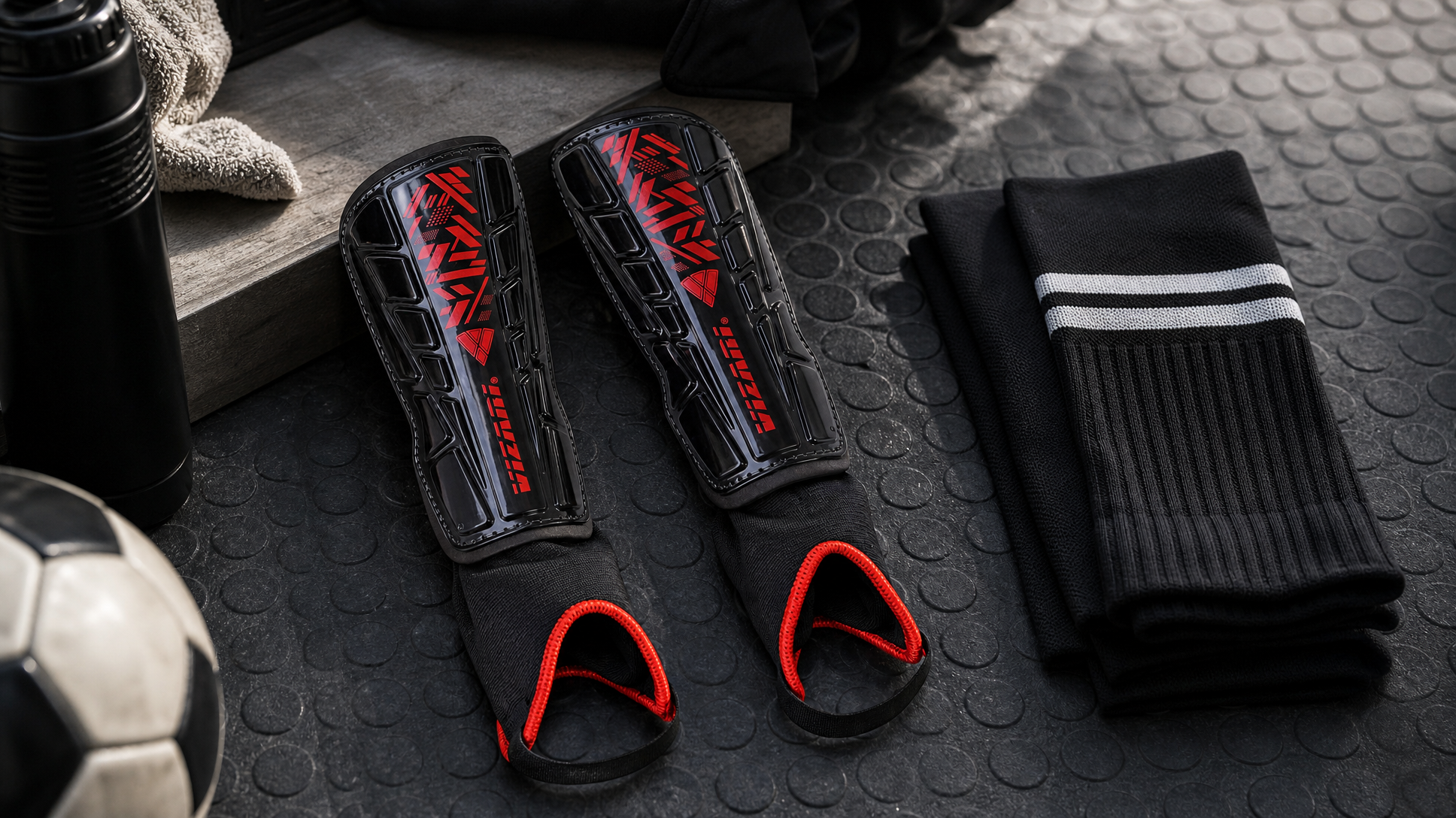
The best ankle strap systems are flexible, adjustable, and loop under the foot rather than relying solely on elastic tension around the ankle. A loop-under-foot design anchors the guard vertically — it physically can't ride up the leg the way a simple ankle wrap can. Look at the Malaga's attached sleeve: it includes ankle loop straps with red-trimmed detailing that you can see in the photo, designed to keep the guard anchored at the correct height on your shin throughout the match. Flexible straps that adjust to your ankle shape mean a secure fit whether you're a youth player or an adult with a larger leg.
5. Sleeve Construction: Where Comfort and Security Meet
The sleeve — the fabric sock-like component attached to the back of the guard — does more work than most players give it credit for. A poorly constructed sleeve bunches under your sock, creates pressure points, and slides independently of the hard shell, which defeats the whole purpose of having an integrated system.
What makes a sleeve actually functional: a snug but not constricting fit, fabric that wicks rather than absorbs sweat, and a construction that keeps the shell centered on your shin rather than letting it rotate. The Malaga's black fabric ankle sleeve is built as part of the guard system, not an afterthought. It keeps the shell positioned correctly and works with the ankle straps to create a unified fit — not two separate components fighting each other.
Putting It Together: Why These Five Things Matter as a System
None of these five signals work in isolation. A great shell on a guard with a terrible sleeve is still a guard you'll be adjusting every ten minutes. A well-ventilated design with a flimsy ankle strap is still going to slide. The Vizari Malaga is built around the idea that protection, fit, and comfort have to work together — lightweight PP shell, EVA foam backing, ventilation channels, flexible adjustable straps, and an integrated sleeve that anchors the whole thing in place.
It's designed for players across ages and skill levels, from kids in their first youth league to adults in competitive recreational play. The integrated ankle protection means you're not choosing between shin coverage and ankle safety — you get both in one system that goes on quickly and stays put.
If you've been tolerating a guard that slips, overheats, or starts falling apart mid-season, it's worth knowing there's a better benchmark to shop against. Browse the full Vizari shin guard collection to see the range, or go straight to the Malaga if these five signals match what you've been missing.
See the Malaga Shin Guard in action — shop it now at Vizari Sports.
Frequently Asked Questions
What size shin guard should I buy for my child?
Shin guard sizing is typically based on height or age, and most brands publish a sizing chart. The key fit check: the guard should cover the shin from just below the knee to just above the ankle, without overhanging either end. When in doubt, measure the length of your child's shin from just below the kneecap to the top of the ankle bone and compare it to the guard's listed coverage length.
Are shin guards with ankle protection better than slip-in guards?
It depends on your position and preference. Ankle guards add a meaningful layer of protection for players who take a lot of contact around the foot and ankle — common in midfield and defensive roles. Slip-in guards are lighter and give more freedom of movement, which some forwards and experienced players prefer. If you're buying for a youth player or someone newer to the game, integrated ankle protection is generally the safer starting point.
How do I keep shin guards from sliding down during a game?
The most reliable fix is a guard with a foot-loop anchor strap, which physically prevents upward or downward movement. Beyond that: make sure the sleeve fits snugly (not loosely) against your leg, wear your soccer sock over the guard rather than under it, and check that the guard is sized correctly — an oversized guard has more room to shift. If your current guard still slides after all that, the sleeve construction or strap design is likely the culprit.
How should I clean and care for shin guards to make them last?
After each session, wipe the hard shell with a damp cloth and let the sleeve air dry completely before storing — never stuff damp guards into a bag. Most fabric sleeves can be hand-washed with mild soap; check the care label before machine washing, as aggressive spin cycles can deform the sleeve shape over time. Keeping them dry between uses is the single biggest factor in extending their lifespan.
Related News

Can You Use Soccer Cleats for Running? Here's What Coaches and Parents Need to Know
The question every soccer parent asks eventually
Your kid just finished a season, the cleats are...

Outdoor Soccer Gear Reviews: What Actually Holds Up After a Full Season of Use
Here's a pattern every soccer parent and recreational player knows: you buy the gear in August, ...

Indoor Soccer Shoes for Kids: How to Find a Pair That Actually Fits a Growing Foot
You order a pair of soccer shoes in your kid's current size, they arrive, and within two weeks y...

Sustainable Soccer Gear for Teams and Families: Why Buying Less, More Durably, Is the Real Win
Last spring, a parent on the sideline mentioned she'd bought her daughter three pairs of cleats ...

Soccer Training in the Off-Season: How to Build a Running Base Without Buying a Second Wardrobe
Every fall, the same thing happens. The season ends, the coach says "stay fit over the break," a...