


Can You Use Soccer Cleats for Running? Here's What Coaches and Parents Need to Know
Recent post
The question every soccer parent asks eventually
Your kid just finished a season, the cleats are barely worn, and the coach says they should keep up their cardio over the break. So the obvious thought is: can't they just run in the cleats they already have? It's a fair question — and the answer is more nuanced than a flat yes or no.
Short version: soccer cleats can work for occasional short runs on grass, but they're not a substitute for a proper running shoe, and using them regularly for road or track running is asking for trouble. Here's why, and where the line actually sits.
What soccer footwear is built to do
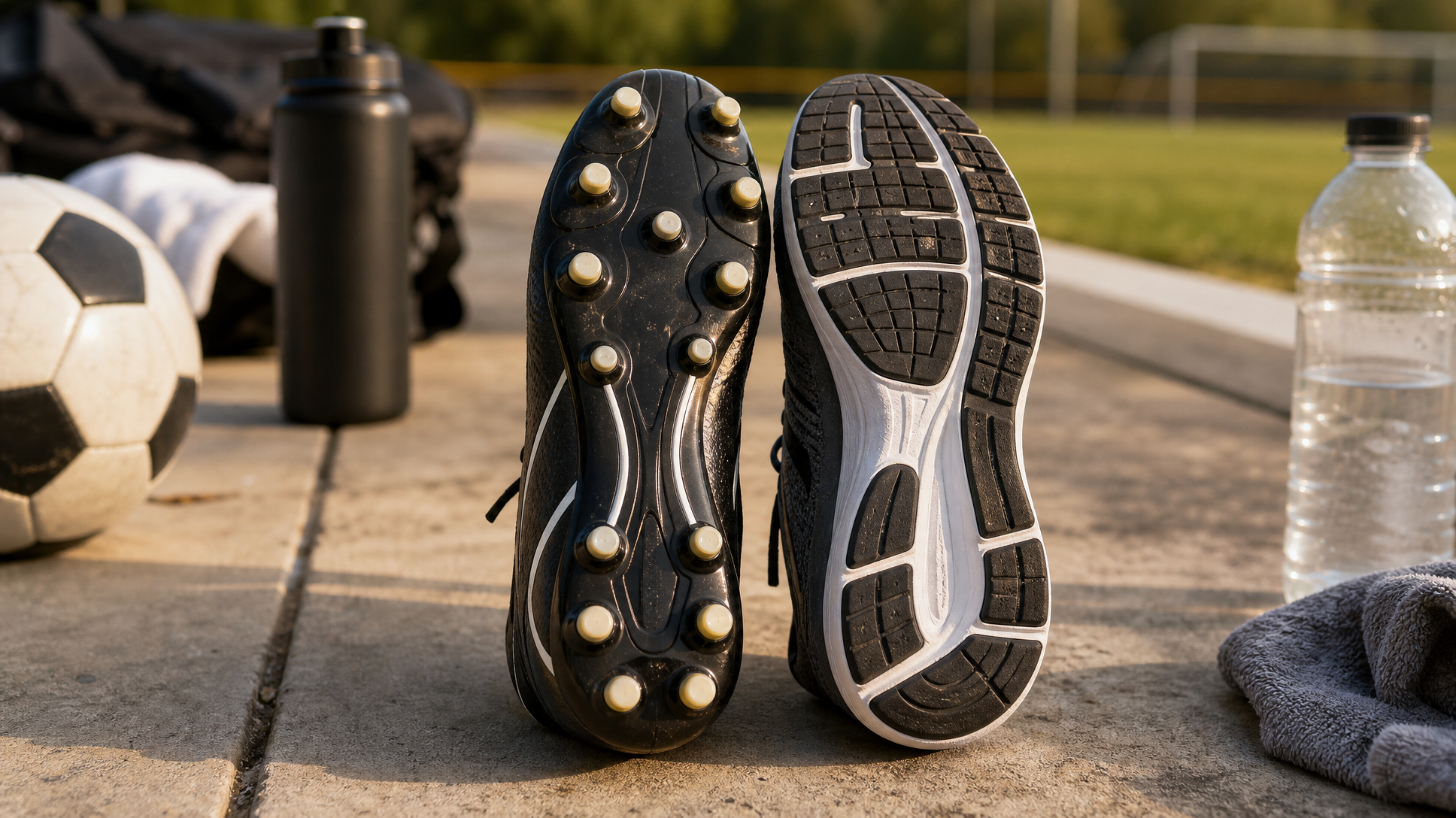
Soccer cleats are engineered around one priority: traction and control on a grass or turf surface. Everything else — weight, cushioning, heel height — gets sacrificed to serve that goal. The outsole is stiff and studded to grip the ground during cuts, sprints, and lateral changes of direction. The upper is usually thin and close-fitting so a player can feel the ball. The heel drop (the height difference between heel and toe) is minimal compared to a running shoe, because soccer players need to stay low and agile, not absorb the repeated heel-strike impact of distance running.
Indoor soccer shoes are a different animal. They have a flat, non-marking rubber outsole designed for gym floors and hard courts. They're lighter and more flexible than cleats, but still built for quick lateral movement — not the forward-only, repetitive stride of a run.
What running shoes are built to do
A dedicated running shoe is designed around a completely different movement pattern. Runners strike the ground with each step in a straight line, generating significant impact that travels up through the heel, knee, and hip. Running shoes are built to absorb and redirect that force — they have thick, cushioned midsoles, a higher heel drop to ease the load on the Achilles tendon, and flexible soles that bend naturally with the foot's forward push-off.
They also tend to be wider through the toe box and softer underfoot. None of that is an accident — it's the result of designing specifically for repetitive, linear impact. Soccer cleats have almost none of those features.
The real risks of running in cleats
Using firm-ground cleats for road running isn't just uncomfortable — it can lead to real problems over time.
- Studded outsoles on hard surfaces. Cleats are made for soft ground. On pavement or a running track, the studs don't compress or grip — they create uneven contact points that put stress on the foot and ankle with every stride.
- Lack of heel cushioning. Without adequate midsole cushioning, the impact of each footstrike transfers directly into the joints. Over a long run, that adds up fast.
- No forward-flex groove. Running shoes bend at the ball of the foot to assist push-off. Most cleats have a rigid plate underfoot that resists that flex, which can tire the foot and calf muscles quickly.
- Lateral-support bias. Soccer footwear is reinforced for side-to-side movement. That extra structure can actually work against you during straight-line running, creating unnecessary stiffness.
For a short jog on grass — say, a warm-up lap or a light training run on the pitch itself — cleats are fine. The surface is forgiving, the distance is short, and you're already wearing them. But a 3-mile fitness run on pavement in firm-ground cleats is a different matter entirely.
When soccer shoes can cover you
Indoor soccer shoes sit closer to the middle of the spectrum. Their flat rubber outsoles make them more suitable for running on a track or gym floor than studded cleats, and some players do use them for light cardio sessions without issue. If a player is doing short shuttle runs, agility drills in a gym, or a quick fitness session indoors, a good pair of indoor shoes can handle it.
Turf shoes — the ones with small, molded rubber nubs — are also more versatile than firm-ground cleats. They're designed for artificial turf and hard natural surfaces, so they sit flatter than traditional cleats. They're still not a running shoe, but for a casual jog on a track or a light training run, they're a more reasonable option than studded cleats.
The honest answer: if the run is short, the surface is forgiving, and the player is healthy, soccer footwear probably won't hurt anything. But if you're building a training routine with regular runs of any meaningful distance, a dedicated running shoe is worth the investment — not because the soccer shoes are bad, but because the right tool for the job makes a real difference.
What to tell your player (or yourself)
Keep the cleats for the pitch. Use them for what they're designed for — and they'll perform better and last longer because of it. For off-season running, a basic running shoe protects the joints, reduces fatigue, and makes the training more effective. That's not an upsell; it's just how the biomechanics work.
If budget is tight and you're choosing between the two, prioritize cleats for a player who's actively in a soccer season. Between seasons, a low-cost running shoe for cardio training is a smarter use of money than wearing out the cleats on pavement.
When it's time to gear up for the pitch itself, check out Vizari's full footwear range — firm ground, turf, and indoor options built for the game, not the road.
Frequently Asked Questions
Can my child run in soccer cleats on a treadmill?
This is one situation where the answer is a clear no. Treadmill belts are not designed for studded outsoles — the cleats can damage the belt surface and create an unstable, uneven stride that increases injury risk. Stick to running shoes on a treadmill.
Are turf shoes better than cleats for running?
Yes, turf shoes are generally more versatile. Their flat, multi-stud rubber outsoles sit closer to the ground and work on a wider range of surfaces, making them a more reasonable option for short training runs than traditional firm-ground cleats. They're still not a substitute for a proper running shoe, but they're a better compromise if you're in a pinch.
Will running on pavement damage my soccer cleats?
It can, yes. The studs on firm-ground cleats are designed to penetrate soft ground, not grind against hard surfaces. Running on pavement or concrete will wear down the studs faster, potentially shorten the life of the outsole, and reduce the cleat's performance on the pitch when you need it most.
What kind of shoes should soccer players use for off-season fitness training?
For road or track running, a standard running shoe is the right call — look for one with adequate heel cushioning and a flexible forefoot. For gym-based agility drills or indoor court work, a pair of indoor soccer shoes or cross-trainers can work well. The key is matching the shoe to the surface and the movement pattern, not just defaulting to whatever's already in the bag.
Related News

Shin Guards That Don't Slip, Overheat, or Fall Apart Mid-Game: What to Actually Look For
You've been there: forty minutes into a match, your shin guard has rotated sideways, the sleeve ...

Outdoor Soccer Gear Reviews: What Actually Holds Up After a Full Season of Use
Here's a pattern every soccer parent and recreational player knows: you buy the gear in August, ...

Indoor Soccer Shoes for Kids: How to Find a Pair That Actually Fits a Growing Foot
You order a pair of soccer shoes in your kid's current size, they arrive, and within two weeks y...

Sustainable Soccer Gear for Teams and Families: Why Buying Less, More Durably, Is the Real Win
Last spring, a parent on the sideline mentioned she'd bought her daughter three pairs of cleats ...

Soccer Training in the Off-Season: How to Build a Running Base Without Buying a Second Wardrobe
Every fall, the same thing happens. The season ends, the coach says "stay fit over the break," a...