


The Silk Sleep Mask as a Mental Fitness Tool: Why Darkness and Stillness Belong in Your Wind-Down Stack
Recent post
You've done the breathwork. You've silenced your phone. You've maybe even lit a candle. But the moment your head hits the pillow, your brain decides it's the perfect time to replay every awkward conversation from the last decade. Sound familiar?
Here's what most mental fitness advice misses: your nervous system doesn't wind down in a vacuum. It responds to input — light, pressure, sound, temperature. And of all those inputs, light is the one most people completely ignore at bedtime, even when they're otherwise doing everything right.
Why Light Is the Overlooked Variable
Your brain reads light as a signal to stay alert. Even low-level ambient light — a streetlamp through thin curtains, the standby glow of a TV, a sliver under the bedroom door — registers as information your visual cortex has to process. That processing has a cost: it keeps a part of your brain on duty when you're trying to stand it down.
Total darkness removes that cost entirely. It's not a luxury; it's more like clearing the input queue so your mind can actually go quiet. Research supported by the NIH has consistently linked light exposure at night to disrupted melatonin production, which is the hormone your body uses to transition into sleep. Block the light, and you're giving that process room to work.
This is where a sleep mask stops being a travel accessory and starts being a genuine tool.
Not All Sleep Masks Are Doing the Same Job
A thin foam mask and a 100% pure silk mask with a structured blackout edge are solving different problems. The foam mask might take the edge off. The silk mask with a proper light-blocking design is removing the variable altogether.
The Kozi Wellness Silk Sleep Eye Mask is made from 100% pure silk and designed to block 100% of light — that combination matters more than it sounds. Silk sits against your skin without the friction or pressure that cheaper materials create, so there's no distraction from the mask itself. The structured black edge seals out light at the perimeter, which is usually where lesser masks leak. What you're left with is complete darkness with zero pressure on your eyelids — the sensory equivalent of a clean slate.
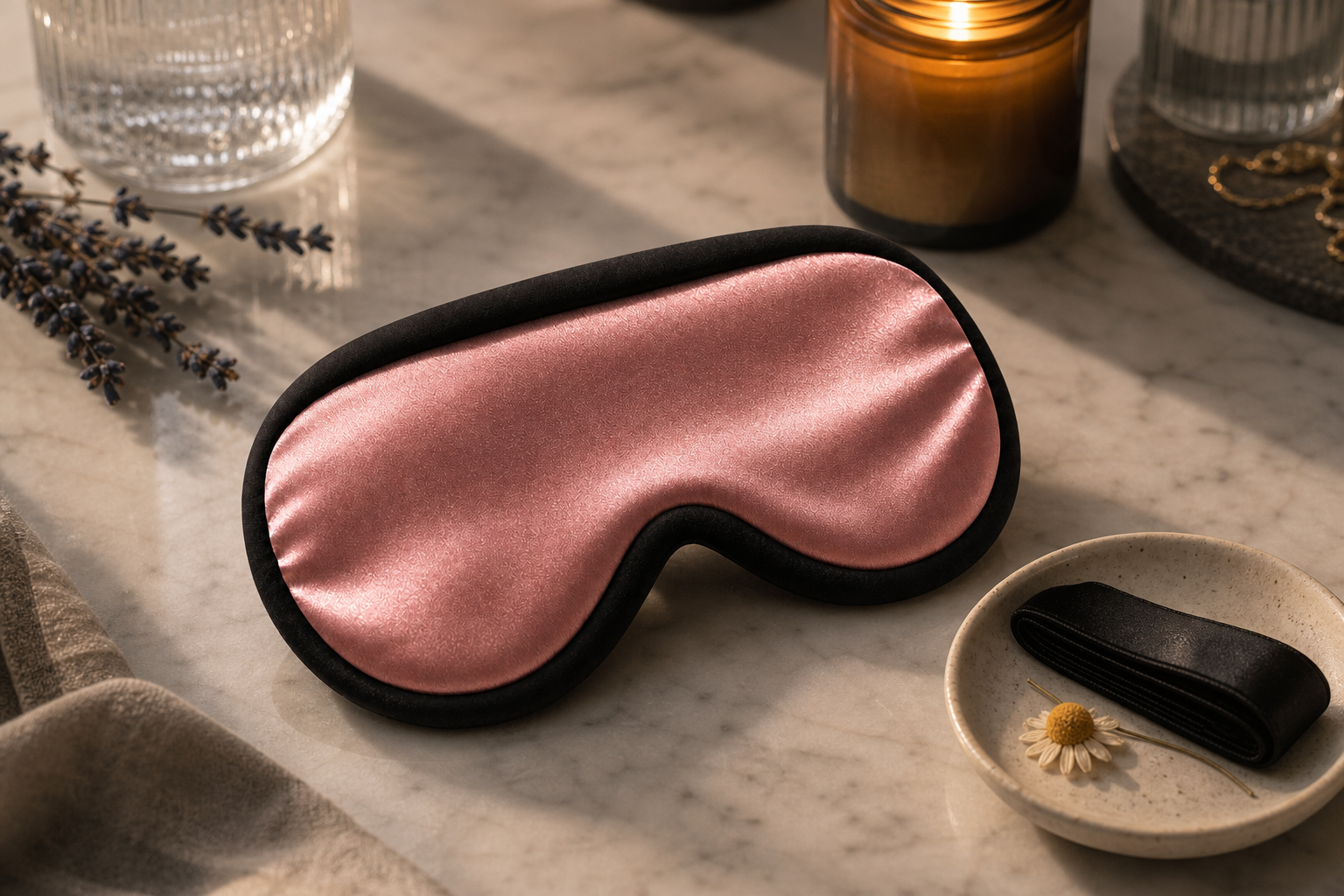
The rose-toned silk face and the close-fitting black border you see in the product image aren't just aesthetic choices. The silk surface stays cool and smooth against your skin, and the border is designed to conform without pressing. When the mask disappears from your awareness within a minute of putting it on, that's the goal — you stop noticing the tool and start noticing the quiet.
How to Actually Use It as a Mental Fitness Tool
Wearing it correctly makes a real difference. Here's a simple wind-down sequence that puts the mask to work rather than just wearing it:
- Set a hard stop on screens. Give yourself at least 20 minutes before you put the mask on. The mask handles ambient light; it can't undo the alerting effect of a bright screen you were staring at two minutes ago.
- Do your breathwork or body scan first. Settle into your mattress, run through whatever calming practice you use, and then reach for the mask. Putting it on becomes a physical signal — a ritual close — that your wind-down is done and it's time to sleep.
- Let the darkness do the work. Once the mask is on and the light is gone, resist the urge to mentally review your to-do list. The absence of visual input is the prompt to let thoughts pass rather than chase them. You don't have to meditate; you just have to stop feeding the queue.
- Keep it consistent. The more reliably you use the mask as the last step in your routine, the faster your brain learns what it means. Consistency is what turns a tool into a cue.
The Case for Silk Specifically
If you've ever woken up with creases pressed into your face from a cheap sleep mask, you already understand the problem. A mask that creates its own discomfort is working against itself — your brain is now tracking pressure and texture instead of letting go.
Silk's natural smoothness means it moves with your skin rather than dragging against it. It also tends to stay at a comfortable temperature rather than trapping heat the way synthetic materials do. For something you're wearing for seven or eight hours, those details compound. A mask you barely notice is a mask that's actually doing its job.
Where It Fits in the Bigger Picture
Mental fitness is a real practice, and like any practice, the environment you create for it matters. You wouldn't try to meditate in a loud, bright room and expect the same results as a quiet, dim one. Sleep is the same — the conditions you set up before you close your eyes shape what happens after.
Journaling, breathwork, and limiting caffeine after noon are all legitimate tools. But they work better when the final input — the sensory environment your brain falls asleep in — is actually conducive to rest. A silk sleep mask that blocks all light is one of the simplest, most direct ways to set that environment. It's not a replacement for the other habits; it's the period at the end of the sentence.
Try the Kozi Wellness Silk Sleep Eye Mask tonight — use code RELAX10 for 10% off at koziwellness.com. One night of real darkness is worth more than a week of half-measures.
Frequently Asked Questions
Does a sleep mask actually help with sleep quality, or is it just a comfort item?
It's both, and the two aren't in conflict. Light exposure at night interferes with melatonin production, which is your body's primary sleep-onset hormone. A mask that blocks all light removes that interference. Whether you feel it as "better sleep" or simply as an easier time falling asleep, the mechanism is real — it's not placebo.
Why does silk make a difference compared to other materials?
The main advantage is that silk is smooth and low-friction, so it doesn't drag against your skin or create pressure points the way foam or polyester can. For something you're wearing for hours at a stretch, a material that you stop noticing is a material that's doing its job. Silk also tends to stay cooler than synthetic fabrics, which helps with overall comfort through the night.
I'm a side sleeper — will a sleep mask stay in place?
Most well-designed sleep masks use an adjustable strap to accommodate different head sizes and sleeping positions. The key is getting the fit right before you fall asleep — snug enough that it doesn't shift, but not so tight that the strap creates pressure. A structured mask with a proper light-sealing edge also tends to hold its position better than a flat, floppy one.
Can I use a sleep mask if I'm not having trouble sleeping?
Absolutely. Even if you sleep reasonably well, removing all light input means your brain isn't doing low-level visual processing through the night. Many people who don't think they have a sleep problem notice they feel more rested after a few nights with a proper blackout mask — simply because the last bit of ambient stimulation has been removed. Think of it less as a fix and more as an upgrade to an already decent routine.
Related News

Do Girls Need Different Soccer Cleats Than Boys? What the Fit Differences Actually Mean
Every season, the same thing happens. A parent walks into a soccer store (or opens a browser tab...

5 Reasons Soccer Apparel and Gym Clothes Are Not the Same Thing (Even When They Look It)
You've done it. Thrown on a pair of gym shorts and a dry-fit tee for a pickup game because your ...

Firm Ground vs. Turf Cleats in Summer Heat: Does the Surface Change How Hot Your Feet Get?
The heat isn't just coming from the sun
Every summer, parents stock up on water bottles, sunscre...

Soccer Color Trends for 2026: What's Actually Showing Up on Pitches (vs. What's Just Runway Noise)
The Gap Between Trend Forecasts and What Players Actually Wear
Every year around this time, colo...

Soccer Kit Layering: What to Wear Under (and Over) Your Match-Day Uniform
The uniform isn't the whole outfit
You show up to a 7 a.m. tournament in March. The sun isn't up...