


Do Girls Need Different Soccer Cleats Than Boys? What the Fit Differences Actually Mean
Recent post
Every season, the same thing happens. A parent walks into a soccer store (or opens a browser tab) looking for cleats for their daughter, and the first question they get is, "What's her favorite color?" Pink? Great, here you go. That's not a fit conversation. That's a colorway conversation dressed up as one.
The real question — the one that actually affects how she plays — is whether her foot needs a different shape of shoe, not a different shade of it. And the answer is: sometimes yes, sometimes no, and it depends on factors most product pages don't bother to explain.
The Actual Anatomy Difference (and When It Matters)
Women's and girls' feet do tend to differ from men's and boys' in a few measurable ways. On average, female feet are proportionally narrower at the heel, wider at the forefoot relative to overall foot length, and carry a higher arch. That combination matters in a cleat because a soccer shoe grips the foot more firmly than a running shoe — there's less cushioning to compensate for a poor fit.
A heel that's too wide lets the foot slide backward on cuts and direction changes. A forefoot that's too narrow compresses the toes during striking. Neither is just uncomfortable — both affect ball control and can cause blisters or black toenails over a long season.
That said, these are tendencies, not rules. Plenty of girls have feet that fit a standard youth last perfectly. The goal isn't to find a "girls' cleat" — it's to find a cleat that fits this foot.
What "Women's Sizing" Actually Means on a Cleat
Some brands engineer a separate women's last — a different mold — that accounts for a narrower heel and slightly different volume distribution. Others simply take the men's shoe, recolor it, and call it a women's version. Those two things are not the same, and product pages rarely tell you which one you're looking at.
When you're shopping, the most honest signal is the sizing chart. If a brand lists a women's size 7 as equivalent to a men's size 5.5, they've likely just converted the number without changing the shape. If they note a different heel width or use the word "last" in their fit description, that's a better sign the geometry is actually different.
For younger players — say, under 12 — this distinction matters less. Kids' feet haven't yet developed the pronounced heel-to-forefoot ratio difference that shows up more clearly in adult sizes. A youth cleat in the right length and width will usually fit fine regardless of whether it's marketed toward boys or girls.
The Colorway Question (Honestly)
Here's the blunt version: color has nothing to do with fit. A pink cleat is not more supportive than a white one. A black cleat doesn't grip better than a neon green one. The colorway is a style choice, and there's nothing wrong with a player wanting a specific color — that's real, and it matters to kids. But it should be the last decision, not the first.
This is where Vizari's approach is worth pointing out. The Vizari Sports Infinity Firm Ground Soccer Shoes in Pink/Black and the Vizari Infinity Youth Firm Ground Soccer Cleats — which come in multiple colorways including white/black, pink, neon green, and orange — share the same cleat construction across colorways. The molded rubber studs, the upper shape, the outsole pattern: identical across the color range. So if the pink version fits well, the white version will too. The color is genuinely just color.
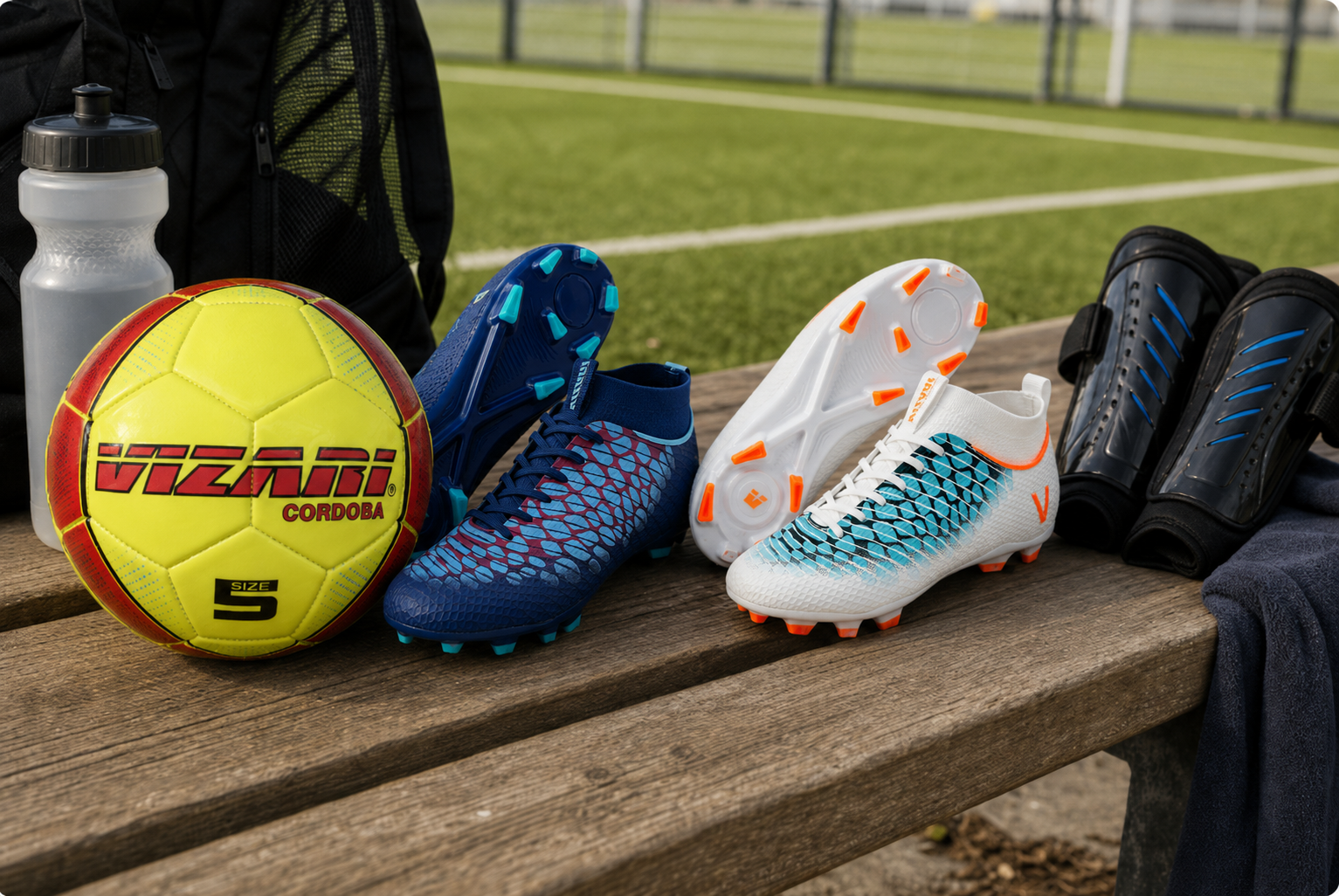
That's actually useful information for parents. It means you can let your daughter pick her preferred colorway after you've confirmed the fit — rather than buying the pink one and hoping it works out.
How to Actually Check Fit Before You Buy
If you're buying online (which most people are), here's a practical approach:
- Measure both feet. Foot length can differ between left and right. Measure at the end of the day when feet are slightly larger. Size to the longer foot.
- Check the width description. If the listing doesn't mention width, assume it's a standard medium. If your daughter has a noticeably narrow heel or wide forefoot, look for that information explicitly.
- Leave a thumb's width at the toe. Cleats should fit snugly — more so than sneakers — but the toes shouldn't be pressed against the end. A little space prevents black toenails during hard shooting.
- Read the return policy before you buy. Fit issues are the most common reason for cleat returns. Knowing you can exchange without hassle removes the pressure of guessing perfectly on the first order.
Youth vs. Adult Sizing: Which to Choose?
This comes up constantly for players in the 12–15 age range whose feet are on the boundary between youth and adult sizes. The honest answer: try both if you can, because the last shape can differ even at the same measured length. Youth lasts are often slightly wider and less tapered — which some players prefer, and others don't.
The Vizari Infinity Youth Firm Ground Soccer Cleats are designed for younger players and come in that same multi-color range. If your daughter is in that in-between zone, it's worth checking whether the youth sizing runs long enough to cover her foot length before automatically moving to an adult size.
What About Firm Ground vs. Other Surfaces?
Fit aside, the other cleat decision that matters is sole type. Firm ground cleats — like the Infinity line — are built for natural grass fields that aren't waterlogged. The molded conical studs provide traction without digging in so deep that they catch on drier turf.
If your daughter plays on artificial turf, a turf shoe (with a flat rubber nub outsole) is the safer choice — firm ground studs can catch awkwardly on synthetic surfaces and increase ankle strain. If she plays on both, some players own one of each. If budget is a constraint, know the primary surface she plays on and buy for that.
For a look at the full range of firm ground options available, the featured soccer shoes collection is a good starting point — it covers multiple styles across age groups and surface types.
The Short Version for Busy Parents
Girls don't automatically need a "girls' cleat" — they need a cleat that fits their specific foot shape. For younger players, a well-fitting youth cleat in any colorway will usually do the job. For older players and adults, it's worth checking whether the shoe uses a genuinely different last or just a different color. And the color? Let her pick that last, once you know the fit is right.
If you want to start with a proven option, the Vizari firm ground cleats give you multiple colorways across both youth and adult sizes — so the fit conversation and the color conversation can stay separate, the way they should be.
Frequently Asked Questions
Are girls' soccer cleats shaped differently than boys' cleats?
Sometimes, but not always. Some brands engineer a separate last (the mold the shoe is built on) for female feet, accounting for a proportionally narrower heel and different forefoot volume. Others simply change the colorway and relabel the size. The safest approach is to check the product description for fit-specific language — or to measure the foot carefully and compare against the brand's size chart rather than assuming the label tells the whole story.
Can a girl wear youth soccer cleats instead of women's cleats?
Yes, if the length fits. Youth cleats often have a slightly wider, less tapered last, which some players prefer. For players in the 12–15 age range whose feet are near the top of youth sizing, it's worth trying both youth and adult sizes if possible, since the shape can differ even at the same measured foot length.
Does the color of a soccer cleat affect how it fits or performs?
No. Color is purely aesthetic — it has no effect on fit, traction, or durability. When the same cleat model is available in multiple colorways, the construction is identical across them. Choose the color your player wants, but make that decision after you've confirmed the fit is right.
What surface are firm ground soccer cleats designed for?
Firm ground cleats are built for natural grass fields that are not waterlogged or overly soft. The molded studs provide traction on drier turf without catching. If your player primarily uses artificial turf, a turf shoe with a flat rubber nub outsole is generally the better choice — firm ground studs can increase ankle strain on synthetic surfaces.
Related News

The Silk Sleep Mask as a Mental Fitness Tool: Why Darkness and Stillness Belong in Your Wind-Down Stack
You've done the breathwork. You've silenced your phone. You've maybe even lit a candle. But the ...

5 Reasons Soccer Apparel and Gym Clothes Are Not the Same Thing (Even When They Look It)
You've done it. Thrown on a pair of gym shorts and a dry-fit tee for a pickup game because your ...

Firm Ground vs. Turf Cleats in Summer Heat: Does the Surface Change How Hot Your Feet Get?
The heat isn't just coming from the sun
Every summer, parents stock up on water bottles, sunscre...

Soccer Color Trends for 2026: What's Actually Showing Up on Pitches (vs. What's Just Runway Noise)
The Gap Between Trend Forecasts and What Players Actually Wear
Every year around this time, colo...

Soccer Kit Layering: What to Wear Under (and Over) Your Match-Day Uniform
The uniform isn't the whole outfit
You show up to a 7 a.m. tournament in March. The sun isn't up...